
Find Residents Across New Albany
The best first record depends on what is known. An address belongs in the Floyd County property tools. A full name belongs in MyCase, the voter status tool, or a historical index. An old house calls for deeds and dated city directories. Each record was made for a different public task, so a name in one source proves only what that source says.
Property ownership is not the same as current occupancy. The tax mailing address can differ from the parcel's physical, or situs, address. Renters and other household members may never appear on a property card. The New Albany residents directory therefore works best as a path through several dated records, not as a promise that one result names a whole home.
- Write down the exact name, street address, and date or era being researched.
- Check the Floyd County Assessor or Beacon record for parcel and owner clues.
- Use Indiana's voter-status and MyCase tools only for the facts each is allowed to show.
- Confirm a transfer in the Recorder's deed index, then note the legal description.
- For older residents, search library directories, newspapers, cemetery volumes, and probate.
- Ask the custodian under APRA when an index, image, or older file is not online.
New Albany Resident Records Desks
Several key Floyd County offices share the City-County Building at 311 Hauss Square. The Recorder keeps instruments that transfer or burden land. The Assessor maps ownership and assessment facts. The Clerk handles public court, probate, marriage, and related files. These offices do not maintain a master roll of New Albany residents, but their indexes can connect a person, parcel, case, or event when used with care.
Floyd County Recorder
311 Hauss Square, Room 115
New Albany, IN 47150
812-948-5430
Floyd County Clerk
311 Hauss Square, Room 235
New Albany, IN 47150
812-948-5411
All three offices list weekday hours of 8 a.m. to 4 p.m. The New Albany street directory guide explains the address-first path in more detail.
New Albany Parcel Clues Explained
A parcel record is the practical bridge from a street address to an owner name, legal description, assessment, or recorded transfer. The Assessor handles transfers and splits, construction, land assessment, sales disclosure, and plat mapping. Beacon and the county GIS provide the online starting point, while the Assessor's plat room is the fallback when a full record or older map is not exposed on the web.
Record terms. A parcel is a mapped unit of land. Situs means its physical address. An index points to a record; it is not always the record image itself.
A homestead deduction, taxpayer name, or mailing address should not be treated as proof that a person currently lives on the parcel. Compare the situs address with the mailing address and read the deed before joining two names.
Search New Albany Court Names
Indiana MyCase provides a public statewide route for case searches. The search can begin with a party name, case number, or attorney. Results can then be narrowed by court, status, date, and case type. For a local question, select the Floyd Circuit or Superior court that fits the result rather than accepting every same-name hit from Indiana.
| MyCase control | How it helps | Limit to remember |
|---|---|---|
| Party name | Finds public cases tied to the entered spelling | A common name needs another identifier |
| Case number | Opens a known docket directly | Documents vary by case |
| Court and county | Narrows results to Floyd courts | Another county may hold a related matter |
| Status, date, type | Separates open and older matters | Sealed and confidential files remain excluded |
MyCase is not a complete criminal-history report. Juvenile, adoption, sealed, expunged, and other protected records are not public. The Floyd County Clerk is the correct fallback for a public local document that is listed but not available online.
The official Indiana MyCase search shows the statewide name-search entry point.
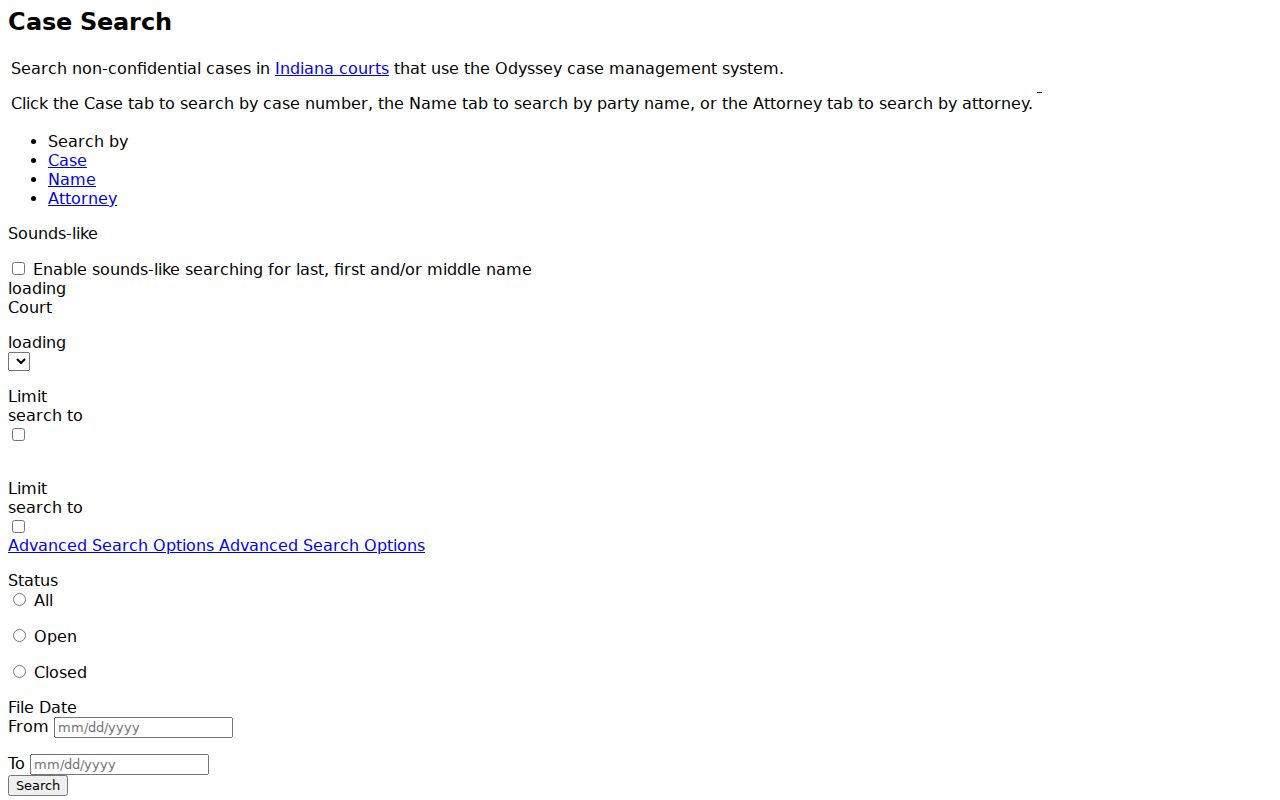
Use the court and county controls to keep a New Albany name from being mixed with unrelated Indiana results.
Current New Albany Resident Sources
Directory-like sources cover roles, not the entire population. A property roll lists an owner or taxpayer. A voter record concerns registration. A deed index names parties to recorded instruments. A permit names people tied to a project. Together, these sources can support a careful New Albany residents directory search, but none should be stretched into a household claim.
| Local source | Names or facts shown | Custodian | Route |
|---|---|---|---|
| Property and parcel roll | Owner, taxpayer, situs, assessment, parcel | Floyd County Assessor | Beacon, GIS, or plat room |
| Voter registration | Status and permitted registration facts | County Election Board and state | Online status tool or lawful request |
| Recorded instruments | Grantors, grantees, liens, plats, leases | Floyd County Recorder | Tapestry, Laredo, or office |
| City permits | Applicant, site, parcel, type, status, dates | New Albany and Floyd offices | SmartGov or records request |
| Public cases | Parties, docket events, public documents | Indiana courts and Clerk | MyCase or clerk counter |
When the goal is one specific person rather than an address, the New Albany resident lookup workflow shows how to test identity across independent records.
New Albany Voter Record Boundaries
Indiana's public voter-status tool is useful for checking registration, but it is not an open household directory. Indiana does not register voters by party. Primary participation codes may appear in vote history, yet an individual's ballot choices are never stored in the voter file. That distinction prevents a common mistake in resident research.
A full voter-file request uses form VRG-24 and comes with limits on use and redistribution. Social Security numbers, citizenship documents, protected declinations, agency identities, and Address Confidentiality Program records stay out of public view. The public and protected split was restated in the 2026 Indiana election guide.
The state Indiana Voters portal is the official place to check registration status.
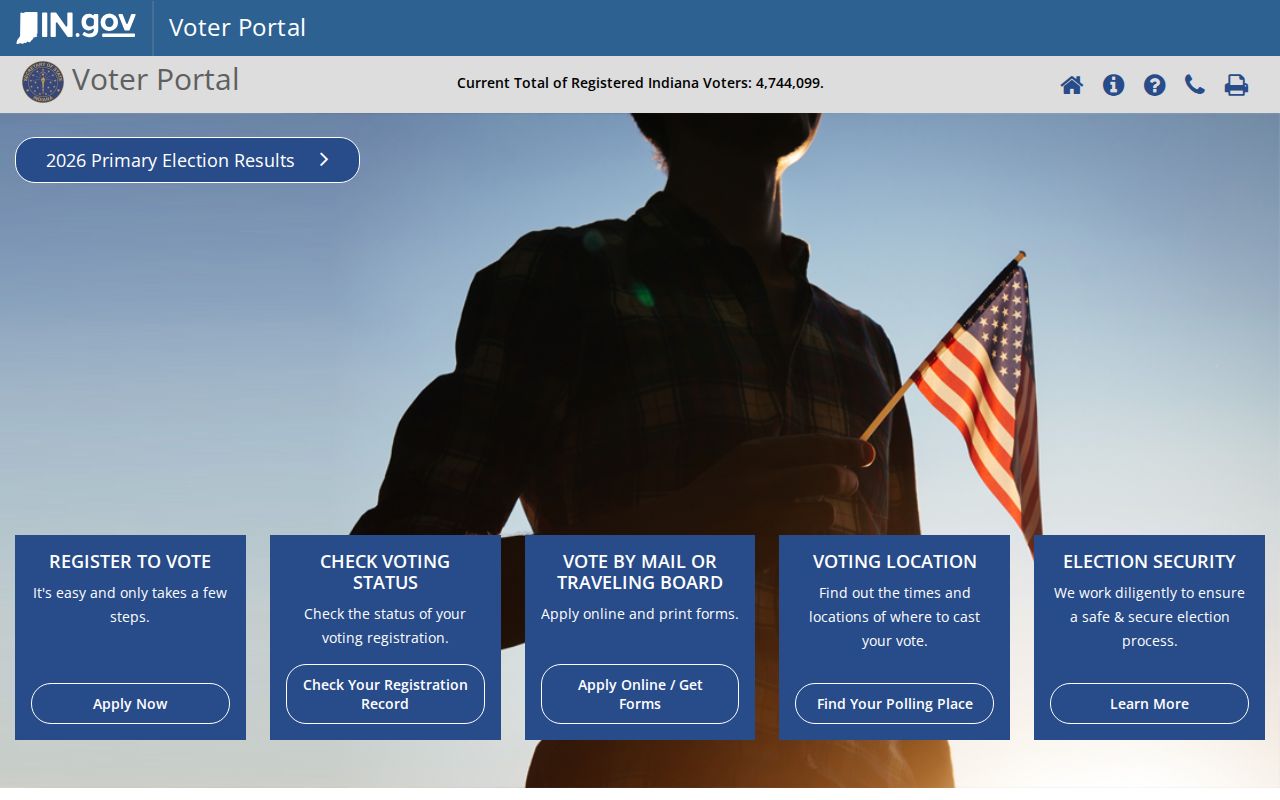
The portal can confirm a permitted registration fact, but it cannot supply a complete list of people living at a New Albany address.
New Albany Deeds Reach Back
Floyd County advertises recorded images from the 1783 Indiana land grants through current material, subject to illegible or deferred items. Tapestry is pay as you go at $8.95 per search plus $1 per printed page. Laredo uses subscription tiers and a local indexing guide. The Recorder's Room 115 counter remains important when a search format, image, or certification cannot be handled online.
Older books use several document-number systems. Books from 1818 through 1853 use letters A through Z except I, later deeds use numbered books, and records from 1974 through 1999 use year and drawer numbers. The local guide also says to omit punctuation and ignore case. Those details can turn a failed query into a useful result.
The New Albany city plan appears in the Clark and Illinois Grant book at code CG00A-137A. That catalog clue connects territorial land material with later lot descriptions. It does not, by itself, establish a modern owner.
Vital Records Follow Separate Rules
Birth, death, marriage, divorce, and adoption records do not share one search or one access rule. Floyd County Health and the Indiana Department of Health handle certified birth and death orders. The Clerk handles marriage and court-side divorce records. Adoption files are sealed. Applicants for restricted certificates must show the direct interest and identification required by Indiana law.
Indiana state birth coverage begins in October 1907 and death coverage begins in 1900. County and library indexes may reach earlier periods, but an index entry is not a certified record. Birth material that has reached the 75-year genealogy threshold follows a different research route from a current certificate request.
The Indiana vital-record ordering page separates the available order paths.
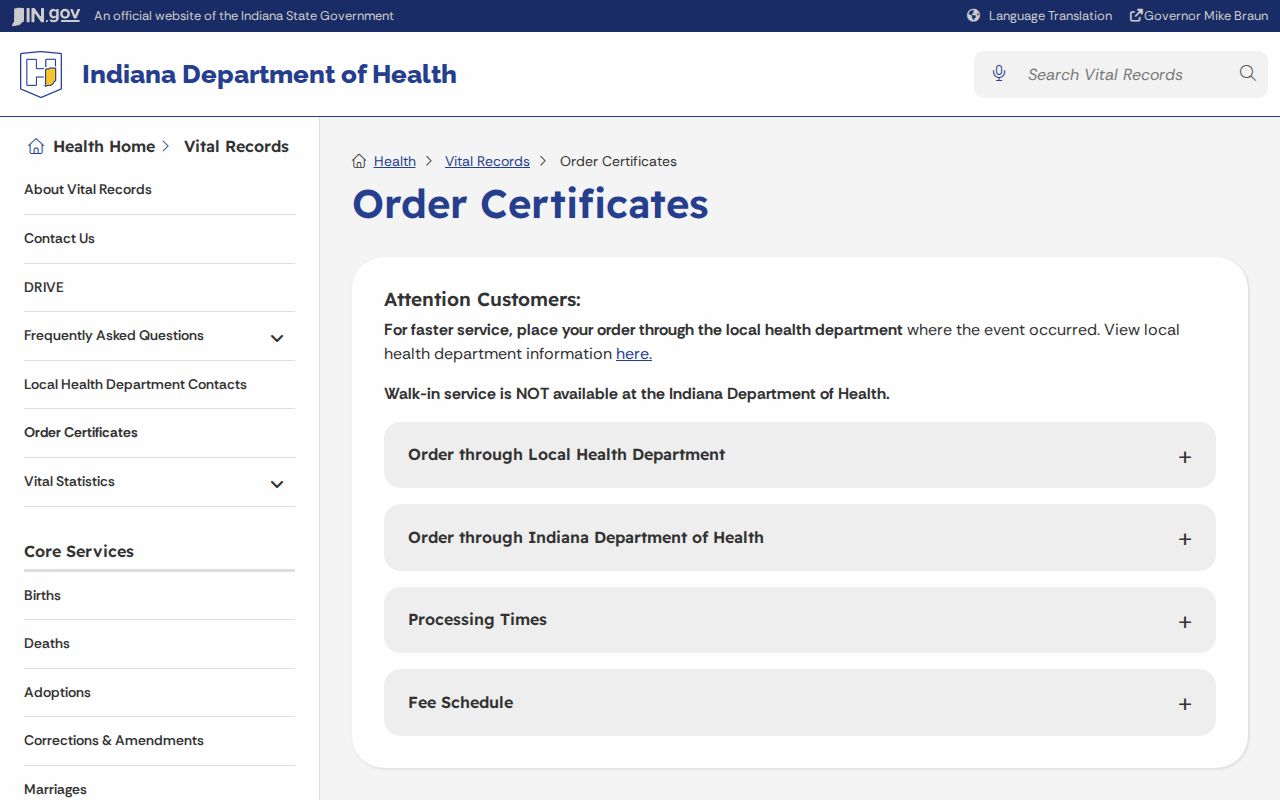
Choose the record type and custodian first, then gather identity and relationship documents before paying for an order.
Read New Albany Historical Directories
The Floyd County Library's Indiana History Room provides the strongest historical resident directory shelf. Digitized New Albany runs begin with an 1845 directory and continue through the 1929–30 Caron volume, with many individual years and combined New Albany and Jeffersonville editions between them. Publishers include Jegli, Grooms and Smith, Hawes, Coy, Williams, Sholes, and Caron.
An old entry may list a name, trade, work site, home address, or boarding place. The 1860 volume also includes a street section and uses short forms such as h, b, and nr, plus corner and side-of-street language. These marks must be checked against the scan because no formal key was exposed. A criss-cross directory reverses the usual name order by arranging entries around streets or addresses.
The library also holds vertical files, newspapers, photos, Fairview Cemetery volumes, databases, and special collections. Remote article and obituary requests are limited to four per month after the index is searched, and an appointment is recommended for archival work. The full year-by-year shelf is covered in the New Albany city directory page.
Trace New Albany Former Residents
To move backward from a house, begin with today's parcel and copy its situs address, mailing address, parcel number, and legal description. Open the current deed, turn its grantor into the next search name, and repeat. The legal description is the continuity check when a street name or number changes.
Directory years can then add people who occupied or boarded at the address but did not own it. Census schedules, obituary and newspaper indexes, probate, and Fairview burial volumes can test family links and dates. Historic Homes adds address images dated from 1969 through 1975, but an image year is only a snapshot, not proof of continuous occupancy.
Fairview's digitized burial books are divided into dated volumes from 1852 through 1949. Picking the volume that fits the event is more effective than expecting a single live search box. The cemetery record can close one trail while probate or a later deed explains how the property moved.
Request New Albany Records Offline
Some searches stop at an interface boundary. SmartGov does not state its historical cutover year. Tapestry may show only its account shell. MyCase document access varies by case. The GIS office notes that paper maps stopped being updated in 2010 and that online GIS grew from a 2012 agreement. A blank result may mean the desired years or images live at the counter.
Indiana's Access to Public Records Act, IC 5-14-3, lets any person inspect or copy public records subject to statutory exceptions. Describe the custodian, record type, date range, person or project, and desired format with reasonable particularity. An in-person or phone request receives a response within 24 hours, while mail, email, or fax receives one within seven calendar days. A response may be an acknowledgment; production takes a reasonable time for search, review, and redaction.
Inspection, search, and review do not carry a fee merely for that work. Copy fees and certification can apply. Ask for the nonexempt portion when a file mixes public and protected material, and request the statutory basis and responsible official if access is denied.
Confirm New Albany Public Roles
A person's public role can separate two otherwise similar names. The Indiana Professional Licensing Agency offers a free, real-time verification search. Its public results can include the license holder's name, credential type, status, issue date, expiration date, and public address. Home phone numbers and email addresses remain confidential under Indiana Code 25-1-5-1. A license match proves a credential and its status, not a current New Albany home.
The Indiana Secretary of State business search adds a different link. Search by an entity or business name, then review the entity type and city or state shown in the result. An agent or filing address belongs to a corporate record and may not be where the person lives. Indiana Unclaimed can also accept a last or business name, first name, city, ZIP, property ID, and claim status. It is a free lead for reconnecting with property, but it cannot confirm a present address.
New Albany's SmartGov permit search connects names with projects. Its advanced controls include application number, permit or license scope, type, process status, submitted, issued, and final date ranges, site address, site city, site ZIP, and parcel number. Status choices run from Pending and Technically Complete through Issued, Finaled, Closed, Inactive, and Expired. The portal does not state its historical start date, so older project records may require the Building and Development office, Planning and Zoning, City Clerk files, or an APRA request.
Use these role records as independent checks. A matching middle name, public business address, license type, or dated permit can distinguish one New Albany resident from another, while the record's purpose keeps the conclusion narrow.
Keep New Albany Searches Lawful
Open records still have firm boundaries. The Address Confidentiality Program provides a substitute address for eligible survivors. Driver information is controlled by the federal DPPA and Indiana law. Vital, court, and voter systems withhold protected data for reasons that an ordinary directory search cannot override.
Use records with care. New Albany resident information is for lawful personal research, civic transparency, family history, and fraud prevention. Never use it to stalk, harass, intimidate, or harm a person.
Keep a source log with the URL or office, the date checked, the exact field searched, and what the result actually states. A second independent source should support any identity match. Corrections belong with the custodian that created the record, since a directory guide cannot change an assessor card, docket, voter file, or certificate.