
New Albany Lookup Sources
No one office keeps a full list of everyone in New Albany. A useful resident lookup joins narrow records held by Floyd County, the city, and Indiana agencies. Property data identifies a legal owner, not each person in a home. A court index links a party to a case, not to a present address. Voter data can confirm registration and precinct facts under strict release rules. Historical sources work best for people who moved or died. Start with the source that fits the known fact, then seek two more points of agreement.
| Record | What It Confirms | Where to Search | Access |
|---|---|---|---|
| Parcel roll | Owner, situs, mailing clue, parcel and legal description | Floyd Assessor and Beacon | Limited public view; vendor or terminal depth |
| Voter registration | Status, residence, precinct and history indicators | IndianaVoters and Floyd voter office | Public fields; VRG-24 limits |
| Court index | Party, court, case type, dates, status and docket | Indiana MyCase and Floyd Clerk | Public cases; protected files excluded |
| Vital and local indexes | Birth, marriage, death and family links | IDOH, Floyd Health, library | Indexes vary; certificates restricted |
| License and entity files | Credential, public role and filing location | Indiana PLA, SOS and INBiz | Public search; private contacts withheld |
With an address, begin at the parcel roll and note both situs and mailing fields. With a lawsuit, estate, or divorce, begin at MyCase and narrow to Floyd. For a death or old family link, use the Floyd County Library newspaper index, Fairview burial books, and the proper vital custodian. Each result is dated. One loose name match is only a lead.
Many household names are absent from the official property trail. Utility customer data was not located as a public source, and motor-vehicle addresses are protected. That makes date and source labels essential. An owner's mailing address may differ from the parcel address. A directory entry may show a trade or boarding place. A voter status can be active, inactive, or cancelled. State the narrow fact shown, then compare it with a second official or institutional source before deciding the records describe the same New Albany resident.
The deed index adds another identity check when the person owns New Albany land. Search the current owner as grantee, note the exact indexed form, recording date, document number, legal description, and prior reference, then compare those facts with the parcel. Floyd County advertises recorded images from 1783 to current, but historic books use several number formats and some gaps require the office copy. A grantor or grantee is a party who gives or receives an interest in the recorded instrument. The deed can establish title and a dated transfer. It cannot establish which relatives, guests, or renters occupied the property.
Keep a small research log as the names are tested. For each result, write the custodian, link, search date, exact name form, date range, and the fact it supports. Mark conflicts instead of choosing the answer that seems likely. If two people share a name, a middle initial, spouse, parent, profession, cemetery lot, or legal description can resolve the match. The strongest conclusion comes from independent records created for different purposes. Repeated copies of the same source count as one fact, even when several portals display them.
Search New Albany Court Records
Indiana MyCase is the main statewide public court index. Its name mode supports exact names and a sounds-like option, then lets the user narrow by court, status, filing dates, and case type. Choose a Floyd court to reduce matches from nearby counties. Public results may show the case number, court, parties and roles, attorney, filing date, status, chronological case summary, hearings, and public documents.
The official MyCase search tips explain name, attorney, case-number, wildcard, and date controls. The captured guidance is useful when a New Albany resident lookup returns too many names.
Use initials and spelling variants, then compare the court, dates, role, and case type. A docket match proves a case connection. It does not prove where the person now lives.
MyCase also offers case-number and attorney modes. A known case number is far more precise than a common surname. When the name search reaches its result limit, add a filing window or court rather than choosing the first similar person. Divorce belongs in court records, while probate and trusts are handled through Floyd Circuit. Federal litigation is searched through PACER and the New Albany Division, not MyCase. Those systems should not be blended because each has different coverage and access rules.
Read New Albany Lookup Results
The court index is not the same as the file. Older or missing papers may require the Floyd County Clerk. MyCase excludes sealed, confidential, expunged, juvenile, and adoption matters, while protection orders use a separate route. The Indiana Judicial public-records page explains online access and the clerk fallback.
Save the case number, Floyd court, party role, filing date, status, and public event list. A resident lookup should use those fields to test identity, not turn a legal event into a claim about the whole person. CAPTCHA and online gaps also mean that no result is not proof that no protected or paper file exists.
The Floyd Clerk is the keeper to ask when the index points to a case but an image is absent. Give the case number, party name, court, and a narrow document or date request. Public balances displayed online may be stale. Certified copies, archive retrieval, and local terminal details were not confirmed in the research, so check with the office before assuming a fee or delivery time. That direct request is more reliable than searching a broad name again.
New Albany Vital Record Paths
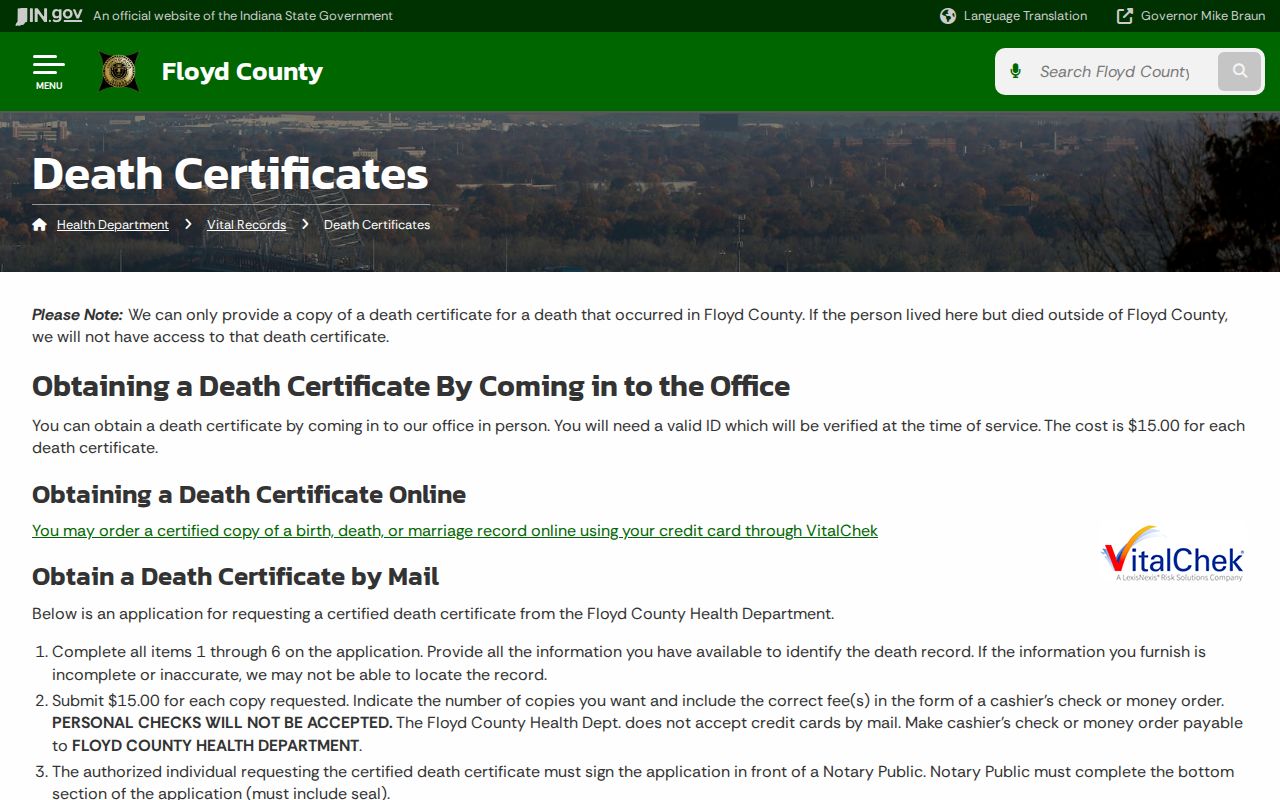
Vital certificates are not a broad name-search tool. Floyd County Health handles certificates for births and deaths that occurred in Floyd County. The Indiana Department of Health keeps statewide records and offers online, mail, and phone ordering. Eligibility and identification rules apply. An index entry may help identify the right person, but it is not a certified certificate.
The Floyd County death-certificate page states the county-event rule and request routes.
For family history, the Floyd County Library adds WPA marriage indexes, newspapers, microfilm, and Fairview burial volumes. Remote newspaper or obituary research is limited to four requests per month. Adoption files stay sealed, so a birth-parent search must begin with the official IDOH registry and eligibility route.
Floyd birth and death certificates are each listed at $15 in the county research, with identification and eligible-interest rules. IDOH's state routes have their own forms, fees, record dates, and processing estimates. A marriage lead may also appear through Clerk materials or State Library holdings, including early marriage books and WPA indexing. Record the event county before ordering. A person connected with New Albany may have an event recorded elsewhere, and the local health office can issue only records within its stated county scope.
Reconnect Through New Albany Records
An heir search starts with Floyd probate in MyCase and the Clerk. Add an obituary, Fairview burial entry, deed transfer, and legal description to distinguish one heir from another. If an estate file is missing online, ask for the named case and date range. Restricted papers may remain unavailable.
A former classmate calls for a different trail. New Albany High yearbooks, Floyd County Historical Society holdings, library vertical files, and newspaper indexes can join a school year to a full name or old address. Historic facts are dated leads. Confirm a later identity through a public filing, obituary, or other independent source before making contact.
The library's Fairview volumes cover 1852 through 1949 and can mark a death-era endpoint. An obituary may list relatives or a last residence, but it is a family-submitted publication and can be incomplete. The city directory collection covers exact runs from 1845 through 1929-30. It may record an occupation, spouse, boarding place, or business address. None of those historical facts alone confirms a living person today. They work best as bridges between a known date and a later official event.
Confirm New Albany Public Roles
Business and professional files can separate two people with the same name. Indiana SOS Business Search and INBiz cover entity, trademark, notary, and UCC routes. A registered-agent or filing address can be a business location, so it should not be called a home address.
The Indiana Professional Licensing Agency search filters by profession, license type, status, name, city, Floyd County, business name, license number, state, and ZIP. Wildcards are supported. Public results can show the credential, public location, issue and expiration dates, and status. Personal home phone and email are confidential. A New Albany resident lookup should describe the public role and stop there.
The free PLA verification is the right place to confirm whether a public license is active and which profession or facility it belongs to. Search and print services cost $1, shown as $1.43 for credit-card payment in the captured research, while bulk downloads have a separate schedule. Entity files can also show an organizer, officer, or agent connected to a New Albany business. These are affiliation facts. Always label the address by the role the record gives it instead of assuming it is residential.
Distinguish Indiana Record Checks
Indiana State Police Limited Criminal History is separate from MyCase. It is a state-only name check based on Indiana data and county participation, not a national history. The form uses name and identity fields, including birth date, sex, and race. Research found a $7 mail fee and a $16.32 online fee.
The ISP Limited Criminal History page is the official source for current rules and request choices.
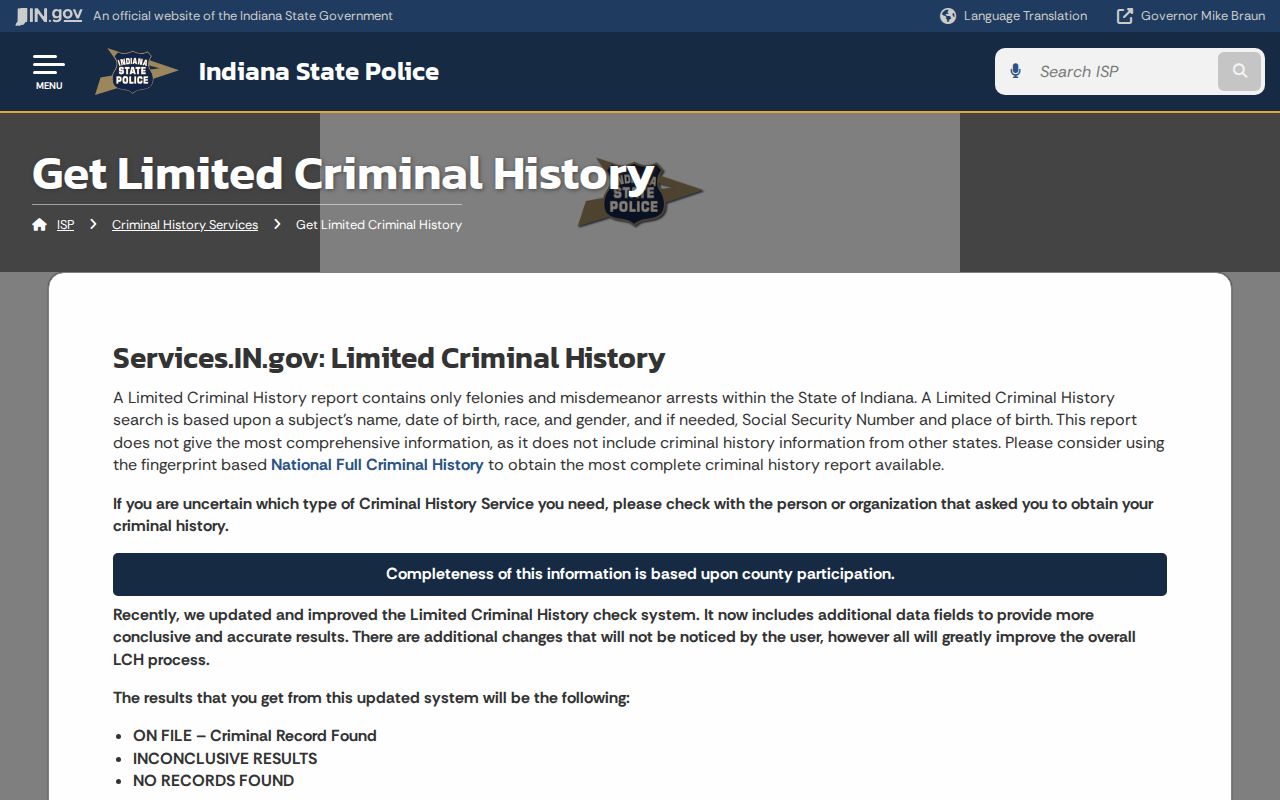
A zero result does not prove there is no protected, federal, out-of-state, or nonparticipating record. For a known public Floyd case, MyCase and the Clerk remain the direct sources.
Verify New Albany Resident Records
Same-name risk is real in New Albany, where long family lines and cross-river ties can produce several plausible hits. Anchor the name to a dated address, then add a family, occupation, age, court, or parcel fact. Married names, widow notations, middle initials, estates, trusts, and OCR errors all need separate searches.
- Search the Floyd parcel roll for the name or known address. Record the parcel ID, situs, mailing address, owner form, and transfer date without treating ownership as occupancy.
- Run MyCase with exact and sounds-like forms. Limit the court to Floyd and compare filing dates, party roles, and case type.
- Check voter status through IndianaVoters or the lawful county process. Indiana does not register ordinary voters by party.
- Confirm an older trail with a newspaper, burial, marriage, yearbook, or vital index. Request a certified copy only from the custodian.
- Docket
- The dated list of filings and events in a court case.
- Index versus image
- An index points to a record; an image shows the filed document and may have separate access rules.
- Certified copy
- An official custodian-issued copy bearing certification, unlike a screen print.
When New Albany Lookups Stall
Dynamic portals fail, older files stay on paper, and some indexes expose only a shell. Indiana's Access to Public Records Act, IC 5-14-3, allows a focused request for nonconfidential agency records. Name the custodian, record type, date range, address, parcel, or case, and desired format. Ask for the separable nonexempt part if protected details are mixed in. APRA cannot open sealed courts or override vital eligibility.
For court files, contact the Floyd Clerk. For property, work with the Assessor, Auditor, Recorder, or GIS office. For local history, the Indiana History Room can search directories, newspapers, vertical files, and finding aids. If access is denied, ask for the statutory basis; the Indiana Public Access Counselor handles disputes.
A focused request is easier for a custodian to locate. Ask for a named permit, case, deed, board packet, or record series. Include the dates and preferred electronic format. The city public-record request PDF returned an error during research, so use the current office contact rather than relying on that broken form. The library is not the custodian for current court, tax, or vital files, but it can bridge old names when an official online trail begins too late.
Note: Save each source date and exact indexed name so corrections can reach the office that owns the record.
New Albany Lookup Privacy Limits
Some records must stop a search. Indiana's Address Confidentiality Program gives an eligible survivor a substitute mailing address for government interactions. Voter systems flag participants as confidential. Courts exclude sealed, juvenile, adoption, expunged, and other protected matters. Driver data is controlled by the DPPA and Indiana law. A missing public hit is never permission to reconstruct a protected address.
Commercial people-data profiles can merge same-name people and copy old filings. Official records, a custodian's current copy, and multiple matching facts are stronger. If a commercial profile is wrong, use the provider's opt-out. If the source record is wrong, contact its custodian.
Corrections belong with the office that created the record. Contact the voter office about a registration entry, the Assessor or Recorder about property records, the court or Clerk about a court entry, and IDOH or Floyd Health about a vital amendment. A deed error may require a new recorded instrument and legal advice. If a portal merely copies the source, correcting only the copy leaves the official record unchanged. Keep the old screen, request date, response, and corrected copy together.
Lawful use. Use a New Albany resident lookup only for lawful personal research. Never stalk, harass, intimidate, or expose a protected person.