
New Albany Directory Collections
The Floyd County Library directory list is the strongest starting inventory. It begins with a Louisville-New Albany volume and follows changing publishers through the last listed Caron issue. The dates show copies known to be available, not a promise that every year survives. Some books can be read online. Print and microfiche holdings may need help from the Indiana History Room or Indiana State Library.
| Collection | Years | Where Held | Access |
|---|---|---|---|
| Jegli and early directories | 1845, 1848 | Floyd County Library | Listed local holdings |
| Grooms & Smith, Hawes, E. Coy | 1856-57, 1859, 1860 | Library and State Library | Selected scans; print or microform |
| Williams, Sholes, early Caron | 1863-64 through 1882-83 | Library and State Library | Access varies by issue |
| Caron New Albany/Jeffersonville | 1884-85 through 1929-30 | Library and Internet Archive | Several free scans plus local copies |
The run has gaps and title shifts. No separate post-1930 telephone or reverse-directory series was confirmed. Treat 1929-30 as the end of the listed sequence, not proof that no later phone book exists elsewhere.
The earliest titles also mark a change in local record detail. The 1845 Jegli book belongs to a Louisville-New Albany context. The 1848 title page was unavailable. By 1856-57 and 1859, “Business Mirror” appeared in the title, and the 1860 E. Coy issue joined a city guide to the directory. Later Williams, Sholes, and Caron issues continued the address-and-trade record. That sequence helps a researcher choose the closest available snapshot without silently filling an absent year.
New Albany Directory Publishers
Publisher names identify the right city directory. Jegli's 1845 book covered Louisville and New Albany together. Grooms & Smith called the 1856-57 issue a City Directory and Business Mirror. G.W. Hawes used similar words in 1859, while E. Coy & Co. added City Guide in 1860. Williams, Sholes, and Caron followed. Caron later paired New Albany with Jeffersonville, useful when a river worker's shop appears on one side and home on the other.
Search the city, publisher, and year as separate terms. Try New Albany alone and the paired-city title. The publisher line is a timeline, but it does not show annual publication.
The Ohio River setting shaped these entries. New Albany's ferry, mills, shipyards, shops, and factories put trades beside names, which helps separate people who share a surname. A Jeffersonville or Louisville work address does not cancel a New Albany home. It may show the daily cross-river link the paired directory was meant to capture. Search both residence and trade terms when following a worker.
Note: A missing issue is a collection gap, not evidence that a New Albany household moved away.
New Albany's Digitized Shelf
Known online issues include 1856-57, 1860, 1884-85, 1911-12, and 1929-30. Start with page images, then use OCR text to find likely names. OCR turns a scan into searchable text, but worn type can warp surnames and streets.
The digitized 1860 New Albany directory shows the actual volume rather than a modern index.
Use text search to reach a page, then inspect the scan before recording a spelling, number, or short form. The image is stronger when OCR and print disagree.
A good digital search uses several short forms. Try a full surname, initials, a trade, and both modern and printed street spellings. For example, Upper Third may appear as “Upr 3rd,” and a corner may be reduced to compass letters. Search failures can come from OCR rather than from the book. When a match appears, save the page number and nearby entries, since adjacent names and the street section can confirm that the hit belongs to the intended New Albany household.
New Albany History Room Access
The Stuart Barth Wrege Indiana History Room is on the library's main floor. Staff recommend appointments. Contact indiana@nafclibrary.org or 812-949-3527. Hours inspected in March 2025 were Monday 9 to 5:30, Tuesday and Wednesday 9 to 8, Thursday 9 to 5:30, and Friday and Saturday 9 to 5. Verify before visiting.
Vertical files, newspapers, photos, Family Bibles, marriage indexes, cemetery books, Ancestry, HeritageQuest, FamilySearch, and special collections can test an uncertain name. FamilySearch is in person. Vertical files use “Indiana RM Vertical,” and remote digital-copy requests are limited to four per month.
The Indiana History Room service page appears below.
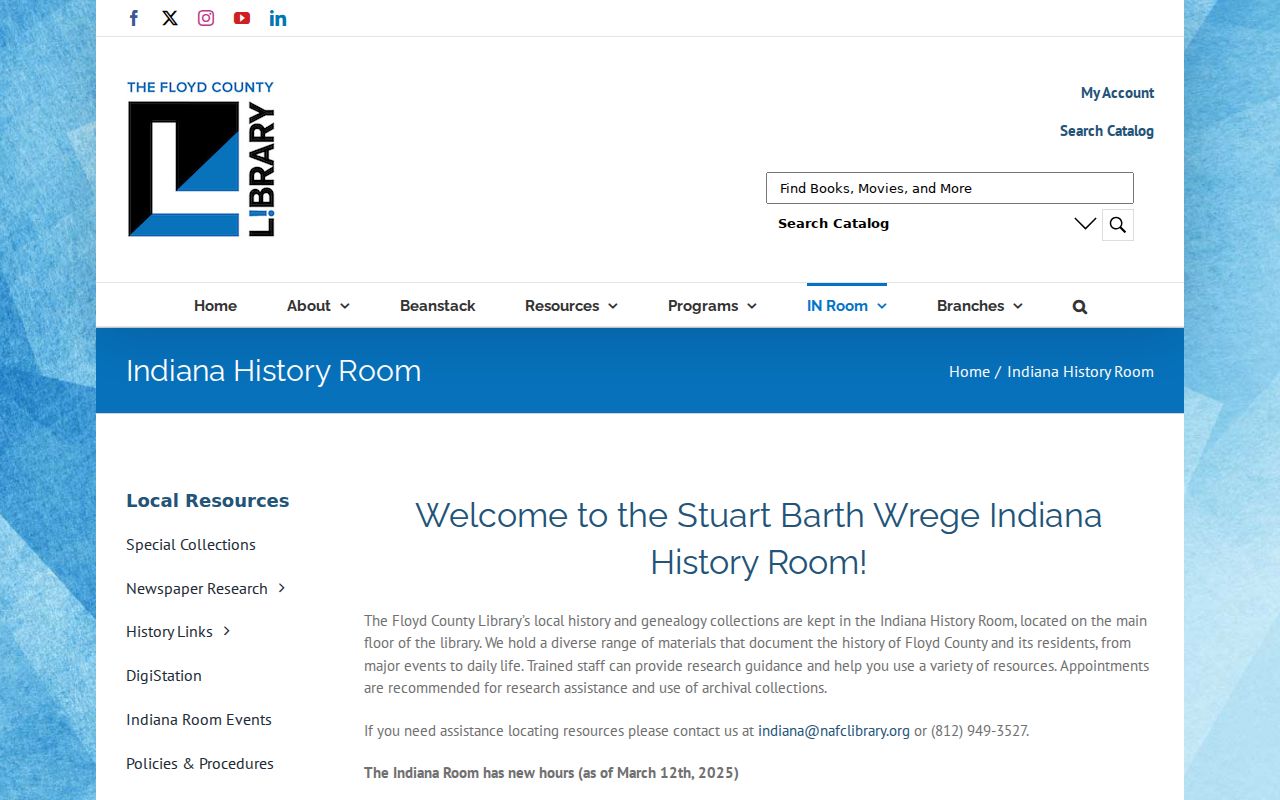
This is the best fallback when a scan is absent or a city directory page is hard to read.
Read New Albany Directory Entries
An 1860 entry can join a name, trade, work address, and home address in one line. One inspected entry describes Jacob Anthony's livery and sale stable, followed by “h” and a Main Street home. Another names Charles B. Applegate, his insurance-company role, and a home at the northeast corner of Spring and Upper Third. These are publication-era facts, not proof of title or present occupancy.
| Person name | Alphabetical heading; initials and OCR variants are common. |
|---|---|
| Occupation | Trade, title, employer, or line of work. |
| Business address | Shop or office, which may differ from home. |
h | Working reading for home, inferred from repeated entries. |
| Corner terms | n e c and side marks describe corners or street sides. |
- Criss-cross directory
- A later street-order or phone-order directory; no separate local post-1930 run was confirmed.
- Householder index
- An address-order list naming the household tied to a place in that publication year.
- Abbreviation key
- The book's legend. None was exposed in the inspected pages, so inferred meanings need scan review.
New Albany's Six-Ward Grammar
The 1860 street section is a map in words. Main lies north of Water, Spring north of Market, and State runs north from the river. Lower and Upper numbered streets, West Union, sides, corners, and six wards appear. This can place a household when modern maps reject an old phrase.
Record exact wording and year before translating it. An early corner is not a present parcel. The 1813 plan was measured with a 33-foot Gunter chain now identified by the Floyd County Historical Society. Old lots and modern street numbers belong to distinct systems. Current address work belongs in the New Albany street directory.
Trace New Albany Family History
A city directory is one dated point in a longer chain. Initials, work sites, and moves across the Ohio River can create false breaks. Keep a log for every issue and separate home from business.
- Begin with a surname, street, or year. Try full and shortened street forms.
- Check alphabetical and street sections. Copy the trade, home, business, ward, and wording.
- Search the nearest issue before and after. Do not assume one number always means one building.
- Pair directory years with census, marriage, death, and newspaper indexes.
- Test ownership with Recorder or Assessor records, then close the trail with obituary, probate, or cemetery evidence.
A missing person may have moved, died, been omitted, closed a business, or appeared under another spelling. One absence proves none of these.
Census years add household structure, while the city directory fills years between federal counts. Marriage and death indexes can explain surname changes. A deed can test ownership. An obituary or Fairview entry may connect relatives. Keep each source's purpose clear, and join records only when dates, addresses, occupations, or family names supply more than a loose name match.
New Albany Directory Trail Endpoints
The library newspaper research service links the New Albany/Floyd index, the 1849-1889 index, databases, and microfilm. Search an index first. Remote article or obituary help is limited to four requests per month, so use a narrow date range.
Fairview burial volumes span 1852 through 1949 in date blocks, not one live form. The cemetery grew from a flooding-prone First Street ground to the Northern Burial Ground in 1841 and took the Fairview name in 1891. Its records add context for the 1844 Lucy Walker explosion burials.
New Albany's Paper Archives
The Floyd County Historical Society inventory can fill a city directory gap. It lists an 1847 city tax book, 1839-43 delinquent taxes, 1848-54 clerk receipts, an 1852 engineer record, 1858-70 leases, 1890-92 building permits, and a 1915 Caron directory. These are holdings, not all digitized files.
The archive inventory screen below distinguishes this route from the library shelf.
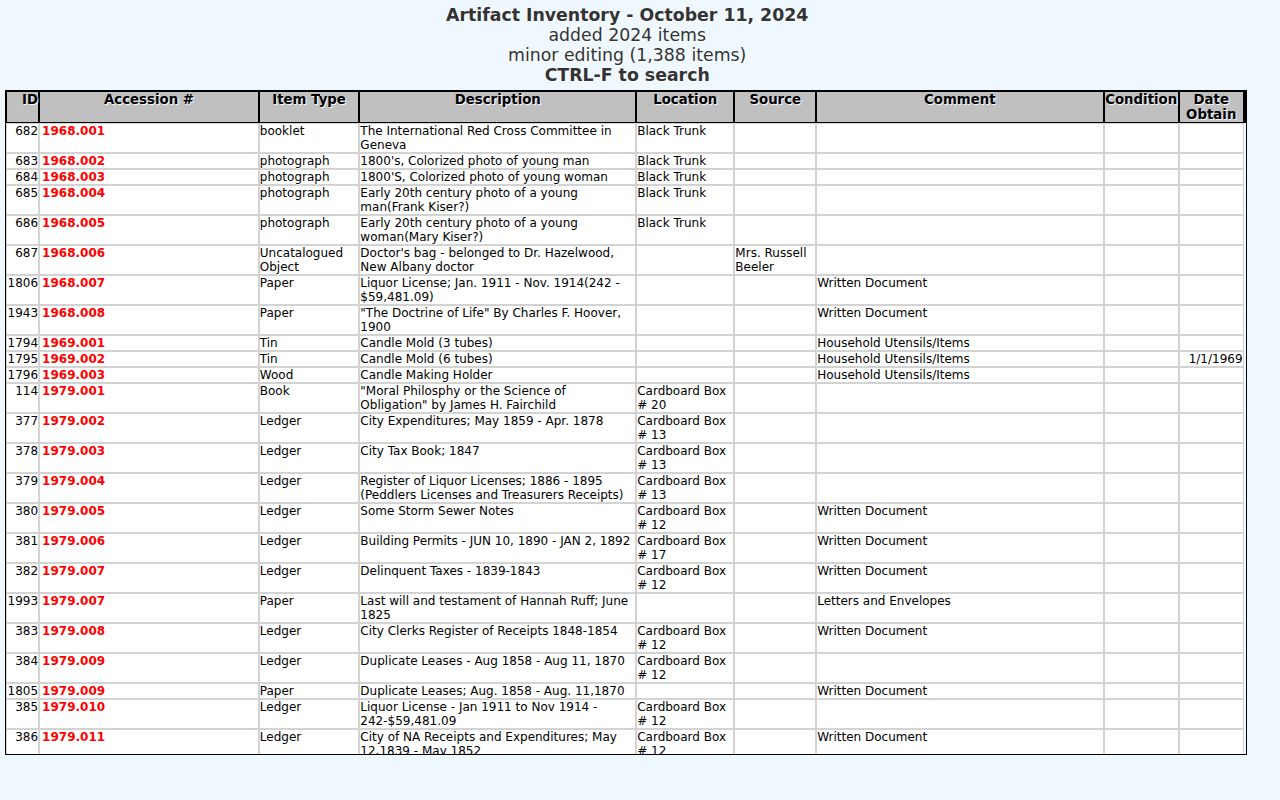
Ask with an item title, person, address, and date range. Yearbooks, church archives, IU Southeast collections, and Historic Homes photos can add school, faith, or building context.
The Historic Homes archive is especially useful when the question shifts from a surname to a building. Its New Albany street pages index address photographs from the 1960s and 1970s, often with more than one image year. A photograph can show exterior continuity or an address spelling, but it is not a deed or proof of occupancy. Pair it with a dated city directory entry, permit register, parcel history, or recorded instrument before drawing a conclusion about the people tied to the property.
Limits of New Albany Directories
The 1860 preface says the canvass visited business and residential places but warned of errors. A missing line is not proof of absence. A listed person may be an occupant, boarder, worker, widow, or business contact rather than the deed owner. A home mark does not certify title.
Label each result with title and year. Preserve uncertain OCR. Compare the image, another issue, and an independent record before joining same-name entries. Historical directories aid genealogy, house history, and family reconnection, but must never support stalking, harassment, or harm.